Laboratory experiments
Numerical and experimental projects (M2S3)
Since 2025, students have the opportunity to work on a project that can be numerical, experimental or both.
Experimental projects
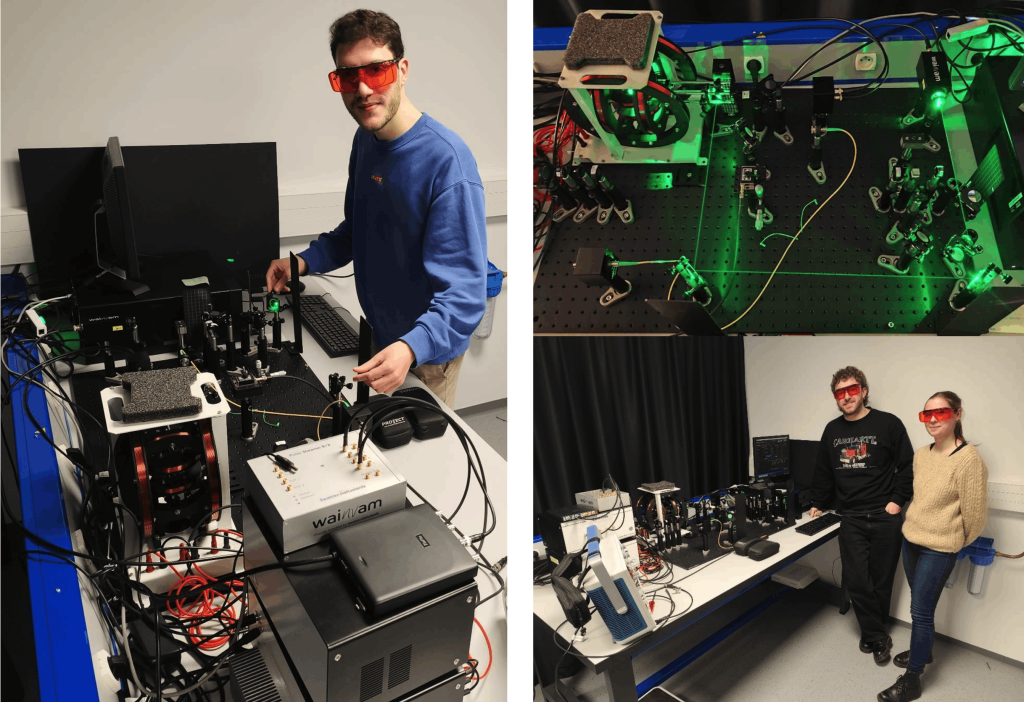 Students may choose to perform an experimental research project on a modern research topic in condensed matter physics. These projects will be conducted during one week (full-time) in research laboratories on the University campus. The project can entail a numerical part related to data acquisition, data analysis and/or data modelling.
Seven experimental laboratory projects (2 at ICS in soft matter, 5 at IPCMS in condensed matter and optics) took place over one week in early November. Students submitted a report and defended it shortly before the Christmas vacations. The list of experimental projects is given below. It will be updated regularly.
- Quantum Hall effect and measurement of the universal ratio e2/h in Graphene Hall bar (see here);
- Primer on magnonic (see here);
- The nitrogen–vacancy center in diamond: a solid state qubit (see here);
- Optical spectroscopy of atomically–thin materials (see here);
- Non axisymmetric minimal surfaces (see here);
- Single-photon counting and application to time-resolved molecular
fluorescence (see here); - Imaging molecular orbitals with a UHV–STM (see here);
- Optical trapping: microparticle dynamics and energetics (see here).
Numerical projects
Alternatively, students may opt for a computational physics course coupled to a numerical project. The objectives of the computational physics course is to provide students with the basic tools for modeling and numerical simulations: knowledge of the basis of Linux operating system, know how to model physico-chemical phenomena, know how to transform the equations resulting from modeling into algorithms to solve them numerically. In particular, teach numerical methods to (1) minimize functions & functionals, (2) integrate differential equations and (3) diagonalize matrices. The student learns also how to develop & compile (where applicable) computer codes that allow numerical resolution of problems.
We will provide students with a series of topics, proposed each year and used as a basis for code development. At first, we will propose 5 themes:
- Monte Carlo method for condensed matter (C. Goyhenex, J. Baschnagel);
- Solving the Schroedinger equation (H. Bulou, M. Alouani);
- Poisson equation in finite elements (R. Herthel);
- Molecular Dynamics (M. Boero, Ori G., C. Goyhenex, J. Baschnagel);
- Tight binding models for electronic structure of solids (M. Alouani, H. Bulou).
Read more here.